Sudoku: The Ultimate Guide to Solving Puzzles and Improving Your Skills
Sudoku is one of the most popular number puzzles in the world, attracting millions of players who enjoy logical thinking, concentration, and mental challenges. The simple grid design makes Sudoku easy to understand, while the wide range of puzzle difficulties keeps the game interesting for beginners and experienced players.
Unlike many traditional games, Sudoku does not require advanced mathematics. The main requirement is logical reasoning. Every puzzle provides enough information to reach a unique solution through careful observation and strategic placement of numbers. This makes Sudoku an excellent choice for anyone who wants an entertaining activity that also encourages mental focus.

What Is Sudoku and How Does It Work?
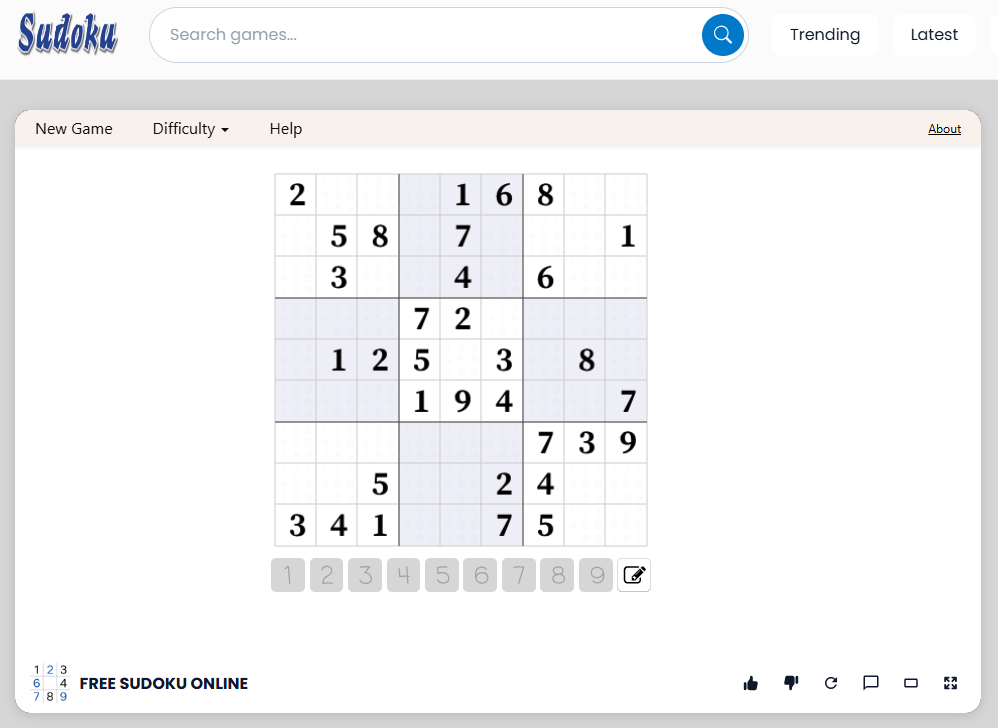
Sudoku is a logic-based number puzzle that normally uses a 9×9 grid divided into nine smaller 3×3 sections. The objective is to fill every empty cell with numbers from 1 to 9.
Each number can appear only once in every row, column, and 3×3 section. Some numbers are already placed in the grid at the beginning of a puzzle. These numbers provide clues that help players determine where the remaining numbers should go.
Understanding the Basic Sudoku Rules
The rules of Sudoku are straightforward. Every row must contain numbers from 1 to 9 without repetition. Every column must also contain numbers from 1 to 9 without repetition. The same rule applies to each 3×3 section.
A correct solution must satisfy all three conditions at the same time. Because of this requirement, placing one number can affect several other cells. A successful player must consider the entire grid rather than focusing on only one area.
Why Sudoku Does Not Require Mathematics
Although Sudoku uses numbers, mathematical calculations are not normally necessary. Players do not need to add, subtract, multiply, or divide numbers to solve a puzzle.
Instead, Sudoku depends on elimination and logical deduction. A player studies the available numbers and identifies which values can or cannot fit into an empty cell. This makes Sudoku accessible to people with different levels of mathematical knowledge.
How to Start Solving a Sudoku Puzzle
Starting a new Sudoku puzzle can seem difficult when many cells are empty. A structured approach makes the process much easier. Beginners should first examine areas that contain many given numbers because these areas usually provide more useful information.
Look for Missing Numbers
Start by choosing a row, column, or 3×3 section with several numbers already filled in. Identify the numbers that are missing and compare them with the surrounding cells.
For example, if a row already contains eight different numbers, only one number remains. The empty cell must contain that missing number. This is one of the easiest techniques for beginners.
Use Candidate Numbers
When a cell cannot be solved immediately, consider all possible numbers that could fit. A candidate number must not already appear in the same row, column, or 3×3 section.
Writing down possible candidates can make complex puzzles easier to understand. As more cells are solved, some candidates become impossible and can be removed.
Search for Hidden Opportunities
Sometimes a number can only appear in one particular cell within a row, column, or section. Even when several cells remain empty, the position of a specific number may be limited to one location.
This technique requires careful comparison between cells. Finding these hidden opportunities can create a chain of new solutions across the puzzle.
Effective Sudoku Strategies for Better Results
As puzzle difficulty increases, basic elimination may not always be enough. Advanced strategies can help players solve puzzles without guessing.
Apply the Naked Pair Technique
A naked pair appears when two cells in the same row, column, or 3×3 section contain exactly the same two possible numbers. Those two numbers must occupy those two cells.
As a result, the same numbers can be removed from other candidate lists within that group. This can reveal new placements and simplify the puzzle.
Understand the Hidden Pair Technique
A hidden pair occurs when two numbers can only appear in the same two cells within a particular group. Even if those cells contain additional candidates, the hidden pair means the two relevant numbers must occupy those positions.
Removing the unnecessary candidates can make the puzzle considerably easier to solve.
Use the Box and Line Interaction
A useful strategy involves comparing a 3×3 section with a row or column. If a particular number can only appear in one row within a section, that number cannot appear elsewhere in the same row outside that section.
This relationship between sections, rows, and columns can help eliminate candidates without requiring random guesses.
Common Mistakes That Can Slow Down Progress
Sudoku rewards accuracy more than speed. One incorrect number can create multiple problems later in the puzzle. Understanding common mistakes can help maintain a consistent solving process.
Avoid Guessing Too Early
Guessing may appear to save time, but it can make a puzzle much harder to manage. If the guess is incorrect, several later placements may also become incorrect.
Logical deduction should remain the main method. When progress stops, reviewing previous candidates and checking relationships between rows, columns, and sections can often reveal the missing clue.
Check Every Number Carefully
Before entering a number, verify the relevant row, column, and 3×3 section. A number that appears correct in one direction may still create a duplicate elsewhere.
Careful checking is especially important when solving difficult puzzles with many candidate numbers.
Do Not Focus on Only One Area
Sudoku is an interconnected puzzle. A number placed in one section can affect several rows and columns. Moving around the grid regularly helps players discover relationships that may not be visible when focusing on a single area.
Benefits of Playing Sudoku Regularly
Sudoku offers more than simple entertainment. Regular puzzle solving can encourage concentration, patience, and structured thinking.
Improve Logical Thinking
Every Sudoku puzzle requires players to evaluate possibilities and make decisions based on available evidence. This repeated process encourages logical reasoning and systematic problem solving.
Support Concentration
Solving a puzzle requires attention to many details at the same time. Players need to remember existing numbers, compare candidates, and recognize patterns throughout the grid.
This makes Sudoku a useful activity for people who enjoy exercises that require sustained attention.
Encourage Patience and Persistence
Difficult puzzles rarely reveal every answer immediately. Players may need to reconsider previous assumptions and explore different logical relationships before finding the next solution.
This process encourages patience and persistence while making each completed puzzle feel rewarding.
How to Become Better at Sudoku
Improvement comes mainly through practice and learning efficient techniques. Beginners should start with easy puzzles and gradually increase the difficulty level.
Practice With Different Difficulty Levels
Easy puzzles help develop familiarity with basic rules and simple elimination. Medium puzzles introduce more complicated relationships, while difficult puzzles require advanced techniques and careful candidate management.
Moving through different levels allows players to build skills naturally without becoming overwhelmed.
Develop a Consistent Solving Method
A consistent method can reduce mistakes. Start with obvious numbers, identify candidates, check rows and columns, and then examine relationships between 3×3 sections.
Over time, these steps can become automatic. Experienced players can then solve puzzles faster while maintaining accuracy.
Why Sudoku Remains Popular
Sudoku has remained popular because the concept is simple but the challenge can be surprisingly deep. A puzzle can take only a few minutes to complete or require much longer depending on difficulty.
The game also works well in many formats. People can solve Sudoku in newspapers, puzzle books, websites, and mobile applications. This accessibility allows players to enjoy the game almost anywhere.
Sudoku also provides a satisfying balance between challenge and simplicity. There are no complicated controls, expensive equipment, or extensive instructions. A grid, a few clues, and logical thinking are enough to begin.
Final Thoughts on Sudoku
Sudoku is a timeless logic puzzle that combines simplicity with challenging problem solving. The basic rules are easy to learn, but mastering advanced techniques requires practice, patience, and careful observation.
Whether you are a complete beginner or an experienced puzzle solver, Sudoku offers an engaging way to test concentration and logical reasoning. By learning fundamental strategies, avoiding unnecessary guesses, and practicing regularly, anyone can become more confident and efficient at solving Sudoku puzzles.
The greatest appeal of Sudoku comes from the satisfaction of discovering a solution through logic. Each completed grid represents a series of decisions, deductions, and patterns that eventually come together into one clear answer. For that reason, Sudoku continues to be an enjoyable mental challenge for players of many ages and skill levels.